Asian currencies, as well as other
USD/MYR went up to 3.0430 from 3.0235 today as of 8:51 GMT.
If you have any questions, comments or opinions regarding the Malaysian Ringgit, feel free to post them using the commentary form below.


The actual meaning of the Foreign Exchange trading is to trade in currencies of different countries globally. This business is coming out as the biggest market with minimum regulations. It also offers the maximum liquidity to the individuals who invest in this market.
The trading business in this market is always performed in terms of pairs, i.e. Currency Pairs. It means that simultaneous buying of one currency and selling of the other one. The exchange rate exists, if we join both these operations; the buying and selling rate.
For instance, you may possibly purchase GBP with Dollars with the expectation that GBP price will increase as compare to that of Dollar. Hence, if the value of British Pound increases in comparison to Dollar, you may sell the position; you therefore, make money in this trading.
The major trading currencies in the Foreign Exchange trading market are USD (US Dollar), EUR (Euro), Australian Dollar (AUD), Japanese Yen (JPY), Great British Pound (GBP), Swiss France (CHF) and Canadian Dollar (CAD).
In this regard the frequently traded currency pairs are:
In order to quote the currency pairs, the first currency is known as the base currency whereas the second currency is referred as quote currency of counter currency. The base currency is identical to one monetary unit of exchange for the eternity, like one Euro, one Dollar, one Pound, etc.
This is renowned as accounting currency or domestic currency and quite often, it is known by the term of primary currency of a Forex currency pair. The rate depicts what amount of quote currency is required to obtain single unit of the base currency.
If some of the currency is quoted in comparison to the US Dollar, it is considered as direct rate. On the other hand, if a currency is not quoted in comparison to US Dollar, it is known as cross rate.
The quote currency is converted into a particular amount of the base currency. This is also recognized as the secondary currency, counter currency or foreign currency. For instance, if a quotation of USD/JPY shows the figure of 1.45. It means that you will acquire 1.45 Japanese Yen for one US Dollar. Likewise the figure of GBP/CHF is 54.36, and then you will get 54.36 Swiss Francs for one GBP.
By and large 100,000 units of the base currency are traded for currency pairs. For instance, if you were purchasing CAD/USD at 0.80; it means that you would be making payment of US$ 80,000 for 100,000 Canadian Dollars. This amount has been derived by multiplying 100,000 with 0.80.
If you feel that a quote is rising, it signifies that there is an increase in the base currency value. You can also state that base currency is getting stronger. On the other hand, if the quote is declining, then it depicts that the base currency is falling.
The leading base currencies are:
Generally the quotation and trading of currency pairs are denoted with the terms bid price and ask price. Bid is actually the rate at which you intend to purchase and ask depicts the rate at which you are aspiring to sell.
For instance, if the USD/CHF currency pair quotation shows the figure of 1.3. If you buy this pair, it shows that for each 1.3 Swiss Francs that you are selling, you will get the amount of one US Dollar. If you sell this currency pair, you will acquire 1.3 Swiss Francs for every single US Dollar sold by you.
Your success depends upon in choosing at least one or two currency pairs that you aspire to trade as a newbie. Once you become self assured, you may append additional pairs in your trading assortment. However, for a novice trader, it is always recommended to confine to one or two currency pairs in order to easily administer the transactions.

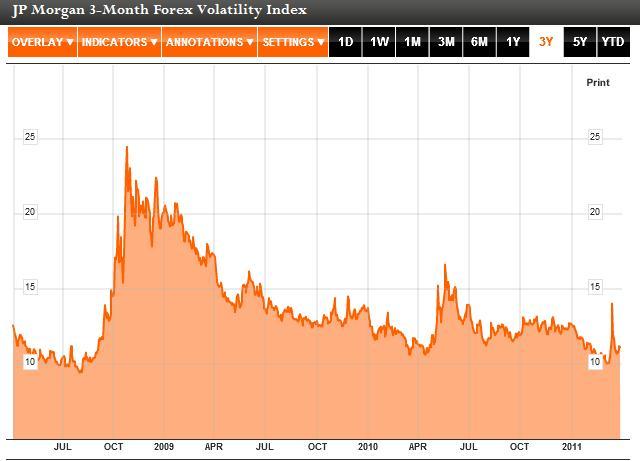
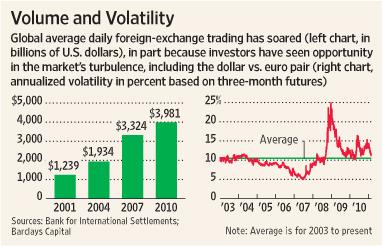
In the last month, volatility in the forex markets touched both a two-year low and a one-year high. In the beginning of March, volatility essentially returned to pre-credit crisis levels. One week later, when the earthquake and inception of the nuclear crisis in Japan, volatility surged 40%. While it has since resumed its downward path, investors are still bracing themselves for continued uncertainty.
The carry trade has perhaps born the brunt of the volatility spike. The carry trade depends on interest rate differentials – as opposed to currency appreciation – to drive profits, and thus demands stability. When the markets become choppy and exchange rates spike wildly in one direction or another, it makes the carry trade significantly more risky. Hence the paradoxical rise of the Japanese Yen to a record high following a series of crushing disasters, as highly leveraged traders moved to unwind their Yen-short carry trades.
Likewise, high volatility should spur demand for so-called safe haven currencies. If only it were clear what constitutes a safe haven currency. Traditionally, that would send the US Dollar, Swiss Franc, and Japanese Yen upwards. In this case, the Franc has benefited most, followed closely by the Yen. The Dollar spiked against emerging market and high-risk currencies, but hardly budged against its G4 counterparts. Could it be that the Dollar’s multi-year positive correlation with volatility has (temporarily?) abated.
With regard to strategy, currency traders have a handful of choices. If you believe that volatility will continue declining or remain stable, you’re probably going to go long emerging market and high-yielding currencies, and short one of the safe-haven currencies, all of which are quite cheap to borrow. The main risk of such a strategy, of course, is that volatility will once again spike, in which these safe have currencies will rally.
If you think that the ebb and volatility isn’t sustainable, then you’re probably going to bet on the Franc, Dollar, or Yen. As I wrote in an earlier post, I think the Yen could theoretically appreciate in the short-term, but actually remains quite risky over the long-term. Despite the best efforts of the Swiss National Bank, the Franc will probably continue appreciation. Economically and monetarily, it is in an excellent shape. Besides, the fact that the supply of Francs is intrinsically small means that even modest capital inflow often translates into a big jump in its its value. As for the Dollar, it is now the most popular currency to short. It remains a safe choice and a good store of value, but probably won’t deliver the returns that safe-haven strategists have come to expect.
From a practical standpoint, you may also want to consider reducing your leverage. As everyone knows, high leverage increases profits but also magnifies losses. In the current environment of heightened volatility, leverage also magnifies risk. Either way, you may also want to consider hedging your exposure, by trading a basket of currencies and/or through the use of options.

There is no universal success formula for making huge profits and getting successful in forex trading industry. If you want to make profit in this industry then you can try your luck.
Being a beginner you can make a successful career in forex market only if you follow effective strategies. It is also advisable to you to buy a book on forex trading to learn the fundamental key points of forex trading before making official entry in this field. This will be of great help for you to go through the details of forex trading trends. Beginner forex traders mostly remain in the search of an ideal forex trading system, but in reality there is no system that can guarantee you success in the highly volatile forex field. The key to success is the application and implementation of effective, flexible and useful strategies and techniques. Your success is highly dependable on your own decisions and systems can only guide you about forex trading to a certain level.
Being a beginner, you have to be clear about your attachment and interest in forex industry. In other words, you have to decide first whether you are associated with forex for long term or short term.
If you select the short term option then you should go for day trading strategy. If you want to stay for long term then go for swing trading or long term trading strategies.
Make sure whatever system you use for trading must be appropriate with your personality.
Generally, the forex market uses two distinct approaches i.e. technical method and discretionary method. Technical method involves the technical indicators that are used to predict forex market trends.
On the other hand, discretionary method involves the fundamental analysis and latest news of forex market that are used to forecast the price action and changes in forex market.
Risk management skills play very important role in forex trading industry. Being a beginner you must bear in mind that you must have the courage to take risks while working in the forex market. You should be confident or over confident about the strategy you are using that it will make profits for you. You should also avoid assuming that your strategy will forecast the directions of market. This is because forex market does not contain fixed directions and you can start trading profitably only when you stop forecasting about the directions of forex market.
You can become a successful forex trader when you work with the correct trading system that not only is appropriate with your personality but also for your lifestyle. Moreover, a correct trading system also involves the usage of best management skills.
Being a beginner, you should be optimistic about your forex business. You can achieve a lot in this industry with little determination and correct strategies.

In order to turn into a flourishing Forex trader, you are required to acquire proper guidance. You must also polish your knowledge and learn the skills of this trait prior to joining this business. In this regard, the one who is providing you training or an online broker must have Forex prediction software. This software should be established on the basis of reliable technical knowledge to assist you about the practical knowledge of market.
Prior to making your choice for Forex prediction software, you must keep in mind that no single technique can be considered as perfect. Hence, this software will also serve as a trading gadget. It will provide you prognosis of the market trends which bestow you with indications to assist you in making your deals.
Majority of the Forex prediction software available in the market are governed by neural system calculating technology. These available Forex prediction software’s are designed to function for diverse time periods as well as markets.
The Forex prediction software is proficient to produce various charts that forecast the market track for two to three days earlier than the actual happening. This type of software is available with the perimeters of producing spreadsheet type of presentation with bunch of columns and graphics. These indicate what is happening in the market.
By and large, the Forex prediction software’s are easy to use and there are also quite comprehensive. The information provided by these is not difficult at all to comprehend. On basis of this data, the investor takes a very short time to decide about making a transaction in a market.
The forecasting made by the Forex prediction software are very precise and also diminishes the ambiguity aspect totally from the trading business. The other main benefit of this software is that you can still evaluate the degree of inaccuracy for future purposes in case the calculations by this software are not correct.
With the help of Forex prediction software, you will be able to set your personal goals and prospects; hence you can eliminate the ambiguity factor that facilitates you to make your transactions based on less number of variables.
This offers you a considerable numerical benefit in taking your decision.
The Forex trading software evaluates a diverse range of markets on daily basis with the help of different neural systems to forecast the subsequent day’s activity in the market. The Forex prediction software has been developed by the computer programmers in collaboration with Mathematicians for the purpose of efficient analysis between different markets.
Ultimate Forex prediction software must have these characteristics:
The Forex prediction software should also facilitate you to do trading as per your aspirations. It must function as single mean of providing trading details or may be utilized to sift besides the current system.

In a recent piece published in the WSJ (“Why the Dollar’s Reign Is Near an End“), Berkley Professor Barry Eichengreen declared that the Dollar will soon cease to be the world’s reserve currency. According to Dr. Eichengreen, within 10 years and for various reasons, the Dollar will become one of many reserve currencies, competing for preference with the Euro, Chinese Yuan, Japanese Yen, and Swiss Franc. While Dr. Eichengreen makes some good points, however, I don’t think most of his arguments stand up to scrutiny.
His thesis can be boiled down into a few premises. First of all, he argues that it is fundamentally illogical that oil should be priced in Dollars, and that countries conducting bilateral trade should settle their accounts using Dollars. Dr. Eichengreen is right that this represents the main underpinning of the Dollar. He is wrong to suggest that it will change anytime soon.
That’s because oil ultimately has to be priced in currency. It’s entirely possible that oil exporting countries will band together and decide to price oil in Euros, instead. However, this would mainly be useful as a political tool (albeit a very potent one!) and would serve no economic or risk management purpose whatsoever. If oil were priced in terms of a basket of currencies (such as IMF Special Drawing Rights), it might make oil prices less volatile, but then would require oil exporters to receive 5 (or more!) currencies for their oil instead of one! Finally, the price of oil can and does adjust relative to what happens in forex markets. When the Dollar declined in 2007, oil prices skyrocketed commensurately in order to compensate exporters.
The same largely applies to bilateral trade. While it makes sense for two countries with stable currencies (such as Korea and Japan, for example) to use one of their currencies as the main unit for trade, the same cannot be said for countries with more volatile currencies. For example, if Argentina and Israel are trading, one country would be inherently dissatisfied if trade were denominated either in Shekels of Pesos. When bills are settled in Dollars, however, it is easy and economical for both countries to simply convert those Dollars into currencies which may have more utility for them. As with oil, it’s possible that some countries will decide that it makes more sense to settle trade in Euros instead of Dollars, but again, I don’t see what purpose this would serve and any such decision would probably be politically motivated.
Second, Dr. Eichengreen points out that changes in technology have made it easy to instantly calculate exchange rates and easily convert currency. While I think this point is well-taken, I think people enjoy having a common base currency, if only for psychological reasons. Ultimately, this point is irrelevant because it has very little bearing on the supply and demand for particular currencies.
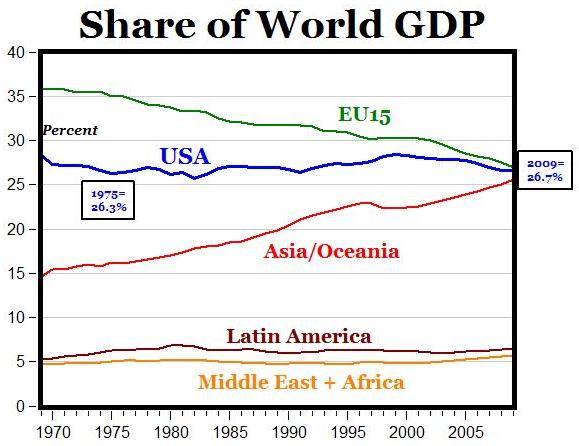
Third, he argues that the Euro and Chinese Yuan both represent latent threats to the Dollar’s preeminence. Again, he’s both right and wrong. The Euro already represents a viable alternative to the Dollar. It’s economy is reasonably strong, its monetary policy is sensible, its capital markets are deep and liquid. On the other hand, it’s being held back by perennial fears about the a Euro breakup, and the fact that the sum of 20 separate parts is not the same as the whole. Since the EU doesn’t issue sovereign debt, risk-averse investors will be limited to buying German/French/etc. bonds, which are always going to be more less liquid and more risky than US Treasury Securities. Besides, you can see from the chart below that the US economy has actually been growing faster than the Eurozone for the last 30 years.
As for China, I expounded in a recent post about how unlikely it is that the Yuan will seriously rival the Dollar anytime soon. While China certainly has plenty of cachet and expanding vehicles for investment, its capital markets remain much too primitive and opaque for Central Banks and risk-averse investors. Most importantly, the structure of China’s economy is such that foreign institutions simply don’t have the opportunity to accumulate Yuan in massive quantities. Simply, the supply is too small. In fact, the Asian Development Bank forecasts that the Yuan will constitute a mere 3-12% of international reserves by 2035. That doesn’t sound very threatening.
Dr. Eichengreen’s final point is that the Dollar’s safe haven status has been compromised. First of all, this is old news. The Yen is already a – if not the – preeminent safe haven currency, thus headlines like “Safe-Haven Yen Gains As Radiation Concern Mounts” that take irony to a whole new level. The same goes for the Swiss Franc. However, any concerns that investors have about the Dollar must necessarily also be projected onto the Yen, Euro, and Pound. All of these currencies face current or looming fiscal crises and slowing economic growth. While investors might diversify into other countries, they’re not going to suddenly dump the Dollar in favor of the Euro.
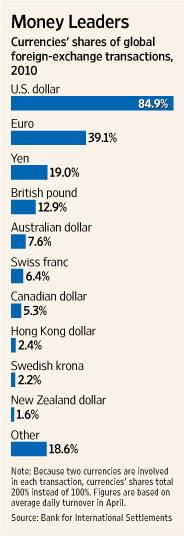
In short, it makes sense that a currency that represents 80% (out of a total of 200%) of all forex transactions and more than 60% of global reserves but only accounts for 25% of GDP, should experience a decline of some sort of decline in popularity. Over the next 50 years, the Dollar will gradually cede share to other currencies. But 10 Years? Give me a break.
A Forex broker has active role in determining the profit realization of a Forex investor. If an investor wishes for a successful business for long time then selecting the right broker is certainly the basic factor. Forex broker reviews are very helpful in selecting a good Forex broker. The Forex broker reviews are good sources to find out the critical points one needs to consider for choosing a broker.
Mostly it is seen that one cannot find out the right image about the broker until they have traded a lot of money. Only to realize that it’s too late to recover the losses. The Forex broker reviews are written after wide research on them and their compatibility with the Forex trading stage. This helps the investor to make accurate decision about trusting on broker and to know the comfort level with different brokers to select the best.
A new trader has to keep in mind a low trading budget as it keep the risk factor at the minimum. For example one can make a ample amount from your small deposit by getting the leverage of 200:1.
While going through Forex broker review it is concluded that Easy Forex is very easy to use. And it is one of the best Forex broker. There are numerous reviews on Easy Forex. It has set innovative user-friendly tools and lowest minimum deposit that are excellent and works wonderful in yielding huge returns.
One more good Forex broker review is regarding eTaro. This Forex trading policy has brought a good reputation among the Forex traders. Because of it many traders are in the profit making direction.
The Forex trading platform is designed such that its like playing game with currency pairs. And it gives so much fun that one does not feel bored with the charts and figures. Forex broker reviews about eTaro makes the traders attentive of the first deposit bonus that is gained while signing up with his broker. The long term trader in the Forex trade having more money to invest can look into other Forex broker reviews such as those on Forex Yard.
This is a place which is intended for more experienced traders. This platform is the one with good leverage, loss protection, low pip spreads, good technical support and equipped with risk minimizing features.
Its spreads are exceptionally competitive and leverages only at deposit of $100. That is good for the new trader to enter into Forex trading.
At the end Forex brokers review includes a very twinkling platform called Pip-Forex. It is perhaps most simple Forex trading. With the help of it new Forex trader easily learns skills and become expert and commercial trader. But it seems to require some of the most basic aspect a beginner should be looking out for. For example, the minimum deposit of $200 is very high for a mini account as compared to Forex Yard and eTaro.
At the end it is important to mention that all currency broker reviews may not fulfill the expectation of the traders. They can even mislead. So trader must analyze the Forex platform reviews carefully. But keep in mind that these Forex broker reviews only guide to select the best one for you and it work depend entirely on the trader-broker relationship, both supporting each other towards the ultimate goal of profit making.

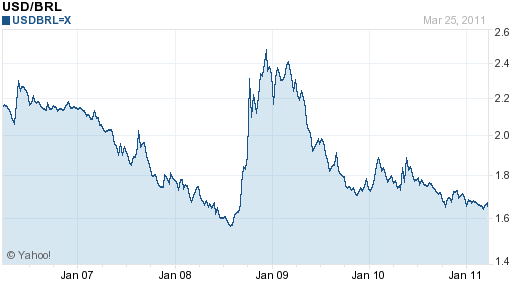
Over the last two years, the Brazilian Real has appreciated a whopping 37% against the US Dollar, second only to the South African Rand. It hasn’t been this strong since prior to the credit crisis, and it is rapidly closing in on a record high. If only Brazilian policymakers hadn’t made it a high priority to prevent that from happening.
The appreciation of the Real is being driven primarily by high interest rates, which in turn, are being driven by inflation. Brazilian prices are now rising at an annualized pace of 6%, which is well above the Bank of Brazil’s comfort zone. As a result, it has already raised rates several times in this cycle, including a 50 basis point hike at the beginning of this month. Its benchmark Selic rate now stands at a stratospheric 11.75%, which is higher than any other currency in the same tier.
Of course, the Bank of Brazil understands the implications of continuing to hike rates. With inflation as high as it is, however, it doesn’t really have much of a choice. Moreover, investors are betting on additional rate hikes, which means even wider interest rate differentials. When you also factor in a surprising lack of volatility surrounding the Real, it will certainly become an even more popular target currency for yield-hungry carry traders.
The government of Brazil, however, is doing everything in its power to repel this kind of speculation, lest it drive up the Real further and threaten the competitiveness of its export sector. In 2010, it tripled the tax rate on foreign investment in fixed income securities, to 6%. It increase scrutiny on local banks that have sought to borrow abroad. The national government has taken to doing more of its borrowing on the international market, and deposited the proceeds directly into its forex reserves, in order to mitigate the impact on the Real. The government is also contemplating punishing short-term investors by establishing a “lock-up” period for foreign capital.
And yet, Brazil finds itself in a quandary. While its trade balance has remained positive, its current account balance is now entrenched in deficit territory. Just like the US, it remaisn dependent on foreign investors to bridge this gap every month. Perennial budget deficits also mean the government can ill afford to alienate lenders. Finally, the government still wishes to attract legitimate foreign direct investment in infrastructure projects and portfolio investment in the stock market.
If Brazil is successful in limiting speculation – which is difficult, but not impossible given its determination – there is a chance that the Brazilian Real will hold steady. After all, Brazil saves less than it needs to invest, and inflation is high enough that there should be some natural downward pressure on the Real. On the other hand, if volatility remains low and speculators continue to find a way around the new capital controls (tempted by 11.75% short-term deposit rates), it will be difficult for the Central Bank to prevent its rise. It can only sit back, continue to hike rates, and pray that speculators soon lose interest.
Personally, I’m betting that the government of Brazil will achieve some measure of success, at least in the short-term. Of all the emerging-market countries engaged in the currency war, it seems to be the most resolute participant after China. At this point, short of fixing the Real to the Dollar, it has shown that it is willing to do whatever it takes to prevent speculators from winning.
Yesterday, UK Chancellor George Osborne announced that his government was ready to begin rebuilding its foreign exchange reserves. Depending on when, how, (or even if) this program is implemented, it could have serious implications for the Pound.
Forex reserve watchers (myself included) were excited by the updated US Treasury report on foreign holdings of US Treasury securities. As the Dollar is the world’s de-facto reserve currency and the US Treasury securities are the asset of choice, the report is basically a rough sketch of both the Dollar’s global popularity and the interventions of foreign Central Banks. Personally, I thought the biggest shocker was not that China’s Treasury holdings are $300 Billion greater than previously believed (with $3 Trillion in reserves, that’s really just a rounding error), but rather that the UK’s holdings declined by 50% in 2010, to a mere $260 Billion.
Given that the Bank of England (BoE) injected more than $500 Billion into the UK money supply in 2010, I suppose that shouldn’t have been much of a revelation. After all, selling US Treasury Securities and using the proceeds to buy British Gilts (sovereign debt) and other financial instruments would enable the BoE to achieve its objective without having to resort to wholesale money printing. In addition, if not for this sleight of hand, UK inflation would probably be even higher.
Still, this is little more than a mere accounting trick, and those funds will probably still need to be withdrawn from the money supply at some point anyway. Whether the BoE burns the proceeds or reinvests them back into foreign instruments is certainly worth pondering, but insofar as it won’t impact inflation, it is a matter of economic policy, and not monetary policy.
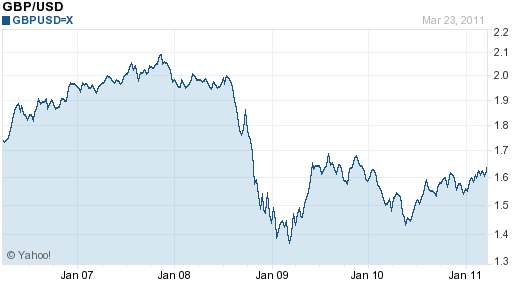
As Chancellor Osborn indicated, the UK will probably send these funds back abroad. In addition to providing support for the Dollar (as well as another reason not to be nervous about the upcoming end of the Fed’s QE2), this would seriously weaken the Pound, at a time that it is already near a 30-year low on a trade-weighted basis. After falling off a cliff in 2009, the Pound recovered against the Dollar in 2010, largely due to the BoE’s shuffling of its foreign exchange reserves. To undo this would certainly risk sending the Pound back towards these depths.
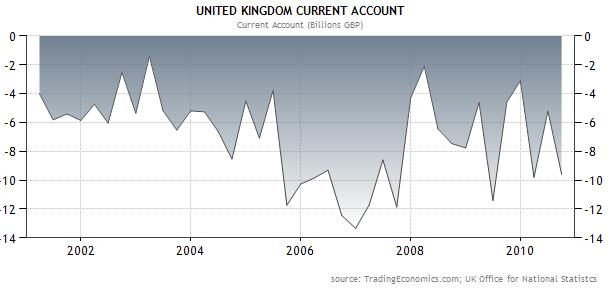
On the one hand, the UK is certainly conscious of this and would act accordingly, perhaps even delaying any foreign exchange reserve accumulation until the Pound strengthens. On the other hand, the BoE is under pressure to fight inflation. It is reluctant to raise interest rates because of the impact it would have on the fragile economic recovery. The same can be said for unwinding its asset purchases. However, if it offset this with purchases of US Treasury securities and other foreign currency assets, it could weaken the Pound and maintain some form of economic stimulus. Especially since the UK has run a sizable trade/current account deficit for as long as anyone can remember, the BoE has both the flexibility/justification it needs to coax the exchange rate down a little bit.
Ultimately, we’ll need more information before we can determine how this will impact the Pound. Still, this is an indication that the GBP/USD might not have much more room to appreciate.
While I’m fondest of analyzing all currencies relative to the Dollar (after all, it’s what I’m most familiar with and is involved in almost half of all forex trades), sometimes its interesting to look at cross rates.
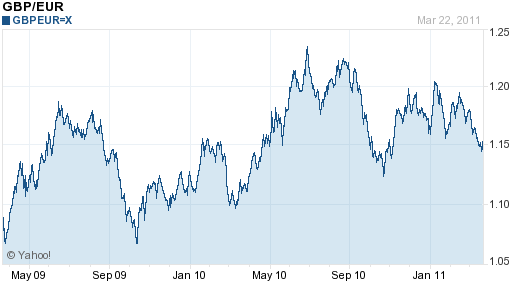
Take the Pound/Euro, for example, arguably one of the most important crosses, and one of a handful that often moves independently of the Dollar. If you chart the performance of this pair over the last two years, however, you can see the distinct lack of volatility. It has fluctuated around an axis of 1.15 GBP/EUR, never straying more than 5% in either direction. In fact, it’s sitting right at this level as I compose this post.
Yesterday, I read some commentary by Boris Schlossberg (whom I interviewed in 2010), Director of Currency Research at GFT. In the title (“Euro and Pound Go Their Separate Ways”), he seemed to suggest that a big move was imminent. Aside from noting that both currencies stand at crossroads, he declined to offer more concrete guidance on the direction of the potential breakout.
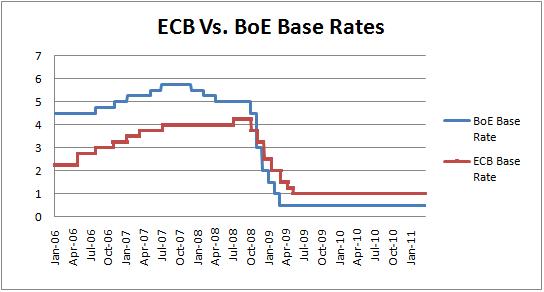
At the moment, the markets are gripped by risk aversion, caused by the Mid East political turmoil and the Japanese natural disasters. Once these events run their course and the accompanying market tension subsides, investors will need something else to latch on to. Perhaps the Bank of England (BoE) and European Central Bank (ECB) can fulfill this function, since both are on the verge of hiking their respective benchmark interest rates . Absent any other developments, the timing and speed of such hikes will probably dictate not only how these currencies perform against each other, but also how they perform against the Dollar.
Despite the numerous indications that both have given to the contrary, I don’t think either Central Bank is in a hurry to raise interest rates. Economic growth remains poor, unemployment is high, and inflation is still moderate. Neither is yet at the stage where it can unwind the monetary easing that it put in place at the height of the financial crisis. Moreover, both are wary about the potential impact of rate hikes on their respective currencies (a concern that I am ironically fomenting with this post).
It looks like the BoE will be the first to act. Combined with high energy prices, the bank’s easy monetary policy is putting extraordinary pressure on prices, and it now appears that inflation could reach 5% in 2011. In addition, the BoE voted 6-3 at its last meeting in favor of tightening, which means that a hike probably isn’t too far off. On the other hand, the ECB is talking tough, but it still doesn’t have much of an impetus to act. Inflation is moderate, and besides, the region’s banks remain too dependent on ECB cash for it to serious contemplate being aggressive.
Either way, the interest rate differential probably won’t be great enough to encourage any short-term speculation between the two currencies. In addition, I think investors will continue to look to the Yen and the Dollar for guidance, and we won’t see any significant movement in either direction. [The chart below is based on benchmark lending rates and isn't necessarily applicable for retail forex trading].
This would create two opportunities for investors: Options traders should consider a long straddle, which involves selling a put and call at the same strike price (perhaps 1.15), pocketing the premiums, and praying that the rate doesn’t fluctuate much (since they would be exposed to unlimited risk). In the future, carry traders can also profit from the lack of volatility through a carry trading strategy, perhaps amplified by a little leverage. Be careful, however. Since interest rate differentials are currently so small (The current LIBOR rate disparity is a mere .05%!) and probably won’t widen to more than 1% over the next twelve months, any profits from interest could easily be wiped out by even the smallest adverse exchange rate movements.
While analysts have been busy dissecting the implications of the natural disasters that ravage(d) Japan for forex markets, the focus has naturally been directed towards the Yen. Given all the rumors about the liquidation of foreign (i.e. Dollar-denominated) assets, it’s also worth examining the potential impact on the Dollar. In a nutshell, Japan’s holdings of US Treasury Securities are extensive, and even a partial unloading could have serious implications for the world’s de facto reserve currency.
As I explained in my previous post, the Yen rose to a record high (against the Dollar) following the earthquake/tsunami/nuclear crisis because of rumors that Japanese insurance companies and other financial institutions would begin repatriating all of their foreign assets in order to pay for rebuilding. (For the record, it’s worth pointing out again that this has yet to take place, and any repatriation is probably related to the approaching fiscal-year end. Thus, the Yen is being propelled by speculation/short squeeze. Period.)
Indeed, Goldman Sachs has estimated that the rebuilding effort will probably cost around $200 Billion. A significant portion of this will no doubt be covered by the payout of insurance claims. How insurance companies will make their claims is of course, unknown. However, consider that Japanese insurance companies have insisted that they have ample cash reserves. In addition, Japan has what is perhaps the world’s most solid earthquake reinsurance (basically insurance for insurers) program, which means primary insurance companies can basically pass these claims up the chain, perhaps all the way to the government.
As for whether the Bank of Japan will sell some its $900 Billion in Treasury holdings, this, too appears unlikely. First of all, the Bank of Japan is doing everything in its power to soften the upward pressure on the Yen, which would not be consistent with selling any of its Dollar-assets. Second, the Financial Times has further argued that they will be especially unlikely to sell US Treasury securities, because they would lose money on (US Dollar) currency depreciation. Besides, any assets that are sold now to pay for rebuilding would probably need to be repurchased later in order to restore balance sheet equilibrium.
While I am on the topic, I want to draw attention to a recent Treasury report that documented the overseas holdings of Treasury securities. The major surprise was China, whose holdings were revised upwards to $1.18 Trillion (from $892 Billion), which means it is well-entrenched as the most important creditor to the US. However, this was offset by a 50% drop in the Bank of England’s holdings, caused perhaps by a change from US debt to British debt.
As I have written in the past, it seems unlikely – for political, economic, and financial – reasons that China will move to pare its Treasury holdings in a significant way. Simply, it has no other viable options for investing the foreign exchange reserves that it is forced to accumulate because of the Yuan-Dollar peg. Other doomsdays have speculated that the crisis in the Middle East will end the “petro-Dollar” phenomenon, whereby oil exporters settle their bills almost exclusively in Dollars and use the proceeds to buy Treasuries. While US influence in the Mid East may indeed wane further as a result of the ongoing political turmoil, I don’t think this will force a change to the PetroDollar phenomenon, which is due as much to unavoidable trade surpluses as it is to settling oil transactions in US Dollars.
There is certainly some concern about what will happen when the Fed wraps up QE2 later this year and stops buying Trreasury securities. Two prominent investment companies (PIMCO and Vanguard) have warned that this will cause bond prices to fall and interest rates on debt to rise rapidly. While this is certainly possible, demand for Treasuries will remain strong for as long as the current risk-averse climate remains in place. In addition, given that the US Treasury is not in danger of defaulting anytime soon, yields reflect expectations for inflation and interest rates more than supply/demand for the bonds themselves. Finally, when the Fed stopped buying mortgage backed securities in 2010, mortgage rates fell, contrary to expectations.
In short, the Dollar might continue to fall against the Yen as speculators cover their short positions, but not because of any fundamental reasons. On an aggregate basis, the never-ending string of crises won’t cause the Dollar to collapse. If anything, it might even bring some risk-averse capital back to the US and re-affirm the Dollar’s status as global reserve currency.